


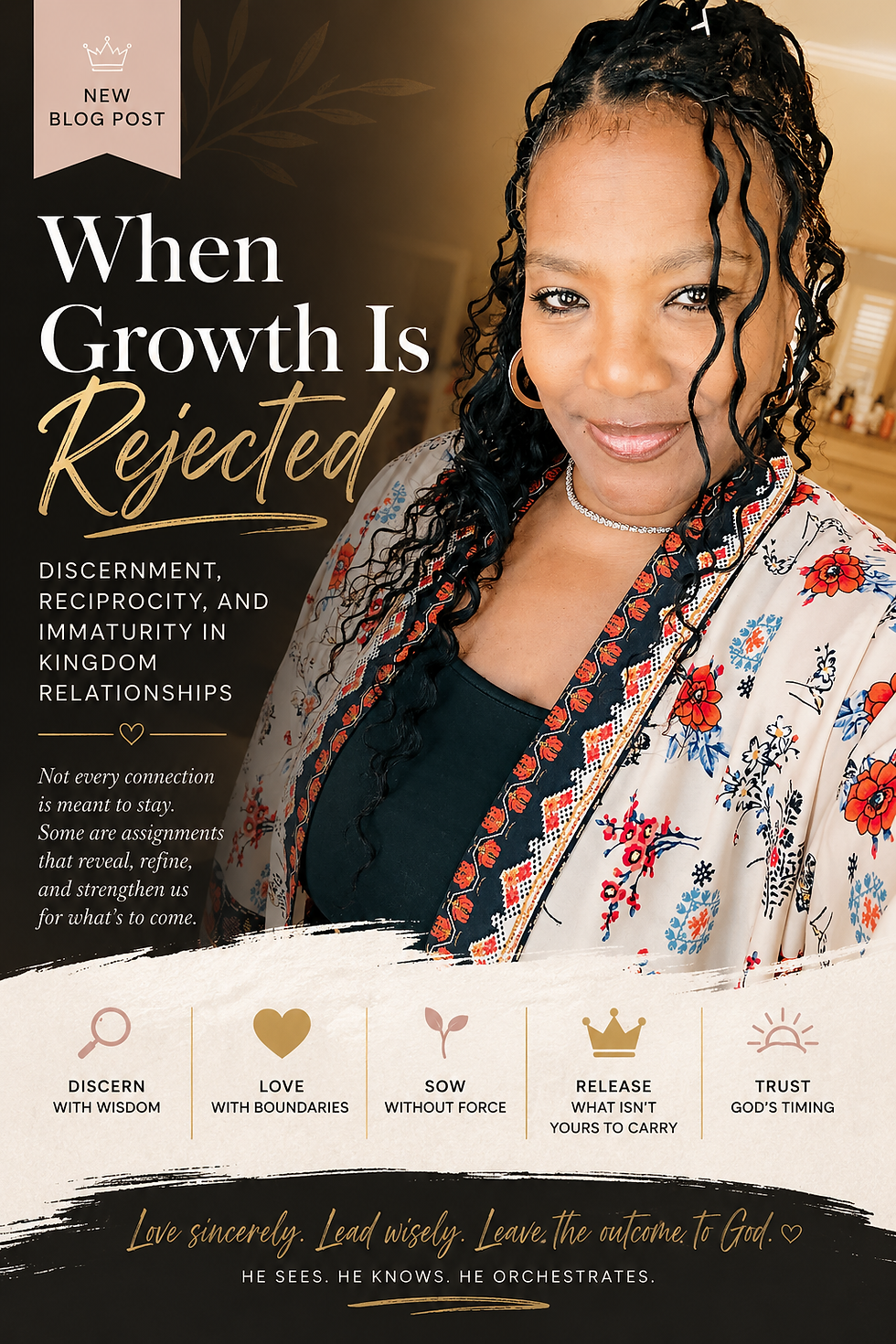
When Growth Is Rejected: Discernment, Reciprocity, and Immaturity in Kingdom Relationships
There are seasons in ministry and relationships where God will allow people to come into your life who immediately trigger discernment in your spirit. You sense immaturity. You sense instability. You sense mixed motives. Yet at the same time, you may also feel led to make room for them anyway. This can create internal tension.
“How do I discern someone’s weakness, yet still show them love?” “How do I remain kind without becoming naïve?” “How do I help people without becoming emotionally entangled?” “What do I do when someone rejects healthy growth because their deeper need was validation?” These are difficult questions, especially for people in ministry, leadership, mentorship, or discipleship.
Not Every Difficult Person Is a Mistake
Sometimes we assume that if discernment warned us about someone, then allowing them into our space was automatically wrong.
But that is not always true.
There is a difference between:
ignoring discernment,
and
obeying God while fully aware of someone’s immaturity.
Jesus knew Judas’ condition from the beginning, yet still taught him, loved him, fed him, and washed his feet. Paul continued laboring with immature believers in Corinth despite their carnality, division, jealousy, and emotional instability.
In many cases, God allows people access to healthy leadership, wisdom, maturity, patience, and love because exposure itself becomes an opportunity for transformation.
The problem is that not everyone who desires connection truly desires growth.
Some People Want Access More Than Transformation
One of the hardest realities to accept is that people sometimes connect to others for the wrong reasons.
They may say:
“God sent me to you.”
“You sharpen me.”
“I need what’s on your life.”
“I believe you can help me grow.”
And all of that may be true.
But growth requires more than admiration.
Growth requires:
humility,
emotional maturity,
patience,
teachability,
self-awareness,
correction,
and the ability to receive without demanding equality or reciprocity.
Many people love the idea of being connected to wisdom until the relationship exposes insecurity, emotional wounds, pride, entitlement, comparison, or hidden motives.
Sometimes people are not truly seeking transformation. Sometimes they are seeking:
validation,
emotional dependence,
reciprocity,
affirmation,
access,
recognition,
or equal positioning.
And when those expectations are not met, disappointment surfaces.
The Misunderstanding of Reciprocity
One of the greatest misunderstandings in kingdom relationships is the belief that all relationships must operate in equal reciprocity.
This is especially common in immature believers.
“If I support you, you should support me equally.” “If I attend your Bible study, you should attend mine.” “If I pour into you, you should pour into me in the same measure.”
But kingdom relationships are not always symmetrical.
Jesus and the disciples were not peers in maturity. Paul and Timothy did not function equally. Elijah and Elisha were not operating in the same role or responsibility.
That does not make one person more valuable than another. It simply means relationships can carry different assignments.
Sometimes a relationship exists because one person is:
mentoring,
strengthening,
stabilizing,
sharpening,
teaching,
covering,
or helping develop another.
Immature people often interpret boundaries as rejection because they equate love with equal access, equal investment, or equal reciprocity.
But mature people understand that healthy relationships honor grace, capacity, assignment, and boundaries.
When Boundaries Expose Motives
One of the quickest ways motives become exposed is through boundaries.
A healthy boundary may sound like:
“I cannot commit to everything.”
“I will support when I am able.”
“I care about you, but I cannot overextend myself.”
“I appreciate you, but I cannot prioritize this in the same way.”
Emotionally mature people may feel disappointed, but they can still honor the relationship.
Emotionally immature people often interpret boundaries personally:
“You don’t value me.”
“You rejected me.”
“You should support me the way I support you.”
When hidden expectations are not fulfilled, motives begin surfacing.
This is why boundaries are not cruel. They are clarifying.
Not Everyone Can Handle Healthy Love
Some people have never experienced:
healthy leadership,
healthy communication,
patience,
consistency,
emotional maturity,
or genuine kindness without manipulation.
When they encounter it, one of two things often happens:
They grow from it.
Their wounds react against it.
Unfortunately, some people sabotage relationships that could actually help them heal and mature because their emotional needs overpower their hunger for transformation.
That is painful to witness, especially when you genuinely wanted good for them.
But you cannot force growth on people who are unwilling to confront themselves.
Discernment Without Bitterness
One of the greatest challenges after relational disappointment is remaining discerning without becoming cynical.
It is possible to:
recognize immaturity,
acknowledge wrong motives,
see manipulation clearly, and still remain compassionate.
Jesus discerned people accurately without becoming hardened toward humanity.
Discernment is not suspicion. Discernment is clarity.
And clarity allows us to:
love wisely,
set healthy boundaries,
avoid unnecessary entanglements,
and release people peacefully when necessary.
Some Connections Are Temporary Assignments
Not every divinely permitted relationship is meant to become long-term covenant.
Some people enter our lives:
to reveal their condition,
to expose our boundaries,
to teach discernment,
to reveal unhealthy expectations,
or to show us the difference between admiration and true discipleship.
Temporary does not mean meaningless.
Some relationships fulfill their purpose simply by revealing truth.
Final Thoughts
One of the hardest things in ministry is realizing that some people will walk away from environments that could genuinely help them grow because emotional needs, insecurity, pride, or unmet expectations become stronger than their desire for transformation.
That is heartbreaking, but it is not your responsibility to carry.
Your responsibility is to:
love sincerely,
remain truthful,
maintain healthy boundaries,
walk in maturity,
and allow God to govern the outcome.
Not everyone who comes into your life is meant to stay.
And not every rejection is a reflection of your failure.
Sometimes it is simply the exposure of motives, maturity, and readiness.


Comments